
What Madison County Tax Records Show
Madison County splits its tax records across two offices. The Commissioner of Revenue values real estate and administers the assessment programs. The Treasurer handles billing, collection, and account activity. Before touching any portal, a Madison County property search should pin down which figure or event matters, because that choice points to the office that holds the record.
| Field or record | What it shows | Where to check |
|---|---|---|
| Land value | Assessed value assigned to the land component | Commissioner / Concise CAMA card |
| Improvement value | Assessed value of buildings or other improvements | Commissioner / Concise CAMA card |
| Tax account and bill | Amount billed, balance, and payment record | Treasurer taxpayer portal |
| Land-use value | Use value and fair-market value for eligible enrolled land | Commissioner assessment record |
| Assessment appeal | Hearing request and decision path for a value dispute | Commissioner and Board of Equalization process |
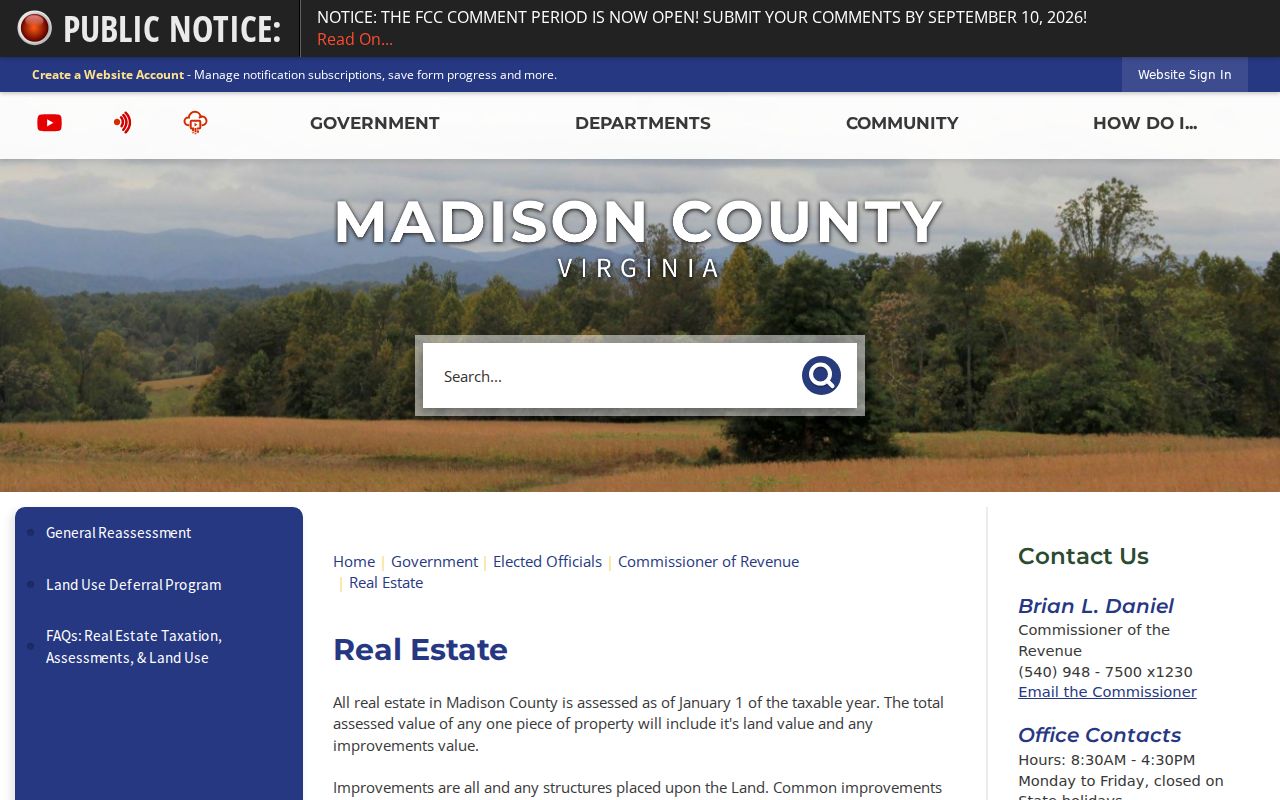
Madison County publishes its Real Estate information page to explain this split. It spells out how assessment, land and improvement values, and tax billing dates each fit into the property records picture.
An assessment card is not a paid receipt, and a bill is not the deed that proves a transfer. Match each question to the office that owns that record.
Lookup a Madison County Tax Bill
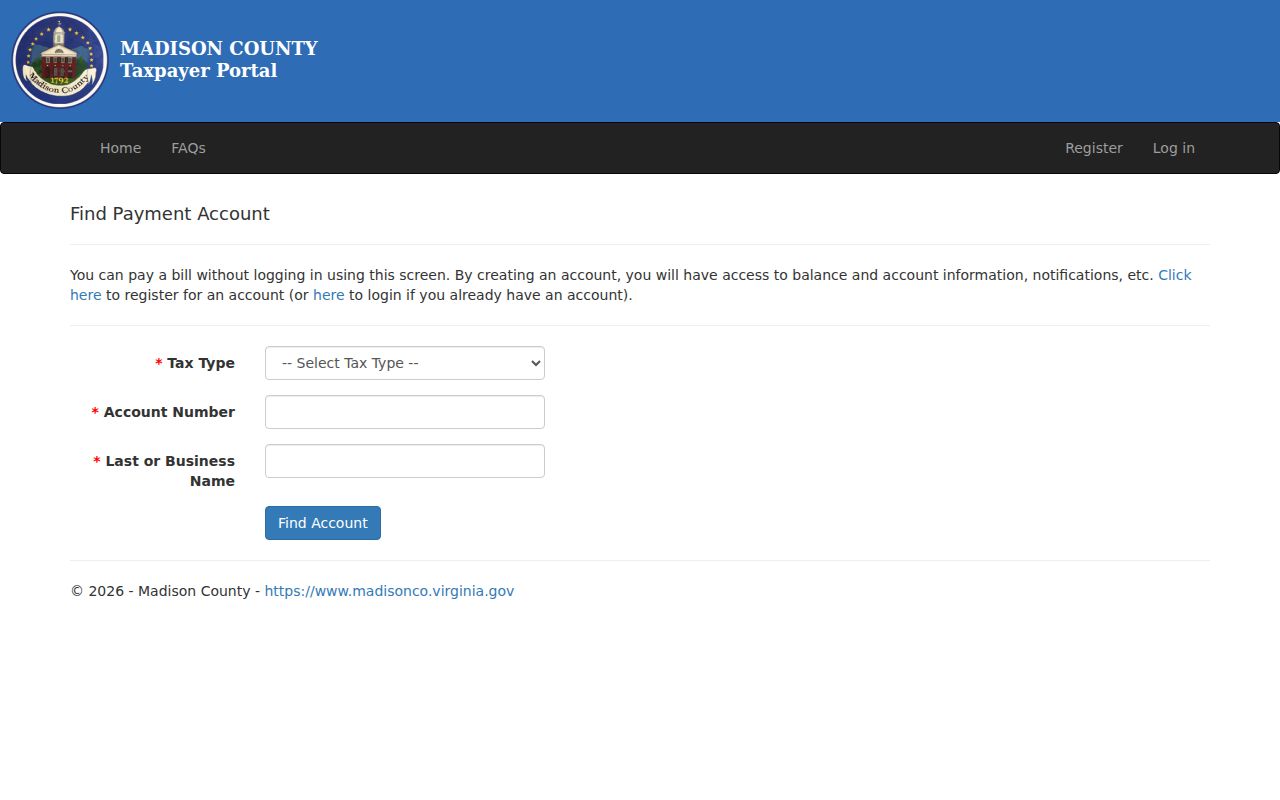
The Treasurer's taxpayer portal speeds up bill lookup. Its public bill finder shows the key account fields. Signing in adds balance details, payment history, and notifications, while quick pay works without a login. The portal lists a card convenience fee and no e-check fee, though the payment screen should be confirmed before submitting.
| Portal field | Type | Lookup note |
|---|---|---|
| Tax Type | Select | Select the relevant type; the source does not list all choices |
| Account Number | Text | Use the account shown on the bill when available |
| Last or Business Name | Text | Enter the name associated with the tax account |
The county's Madison bill lookup form displays those fields. The form is an account search for the tax portal, separate from the county parcel map.
Contact the Treasurer through the county's official site for a missing account or a balance question. A stale deed or value card says nothing about delinquency.
January 1 and the Tax Bill
Madison County does not prorate its tax bills. The January 1 owner gets billed. Unless another arrangement applies, a transfer recorded later in the year may not appear until the next January 1. The newest deed can name one owner. The tax account can still reflect the prior billing record.
When two records disagree, compare the deed's recording date with the tax year. Compare it with the assessment roll date too. The billing record shows what the county charged that account. It does not settle title. Mailing address and parcel situs deserve the same care. They are separate fields that can point to different places.
Rely on the current deed for transfer details. Rely on the Treasurer's account for billed amounts. Madison's tax due dates are June 5 and December 5. Confirm payment status in the live account. You can also confirm it with the Treasurer rather than guessing from paper.
Madison Land and Improvements
Madison County values land and improvements separately. An assessment card may also carry total value, acreage, sale history, exemptions, and land-use details. For a house parcel, weigh the land line against the improvement line first. That comparison shows whether a change concerns the site, the structure, or both.
A parcel change can trigger a value notice. So can active or completed construction, even outside a general reassessment. In 2026, notices went out March 17 and applied to that tax year. A notice is an assessment event. It is not proof of a sale or a new countywide revaluation.
The Commissioner of Revenue sets the assessment. The Treasurer handles bills and payments. Ask the right office when you want a review. Or ask it when you need to match a card to an amount due. That distinction keeps the record hunt from stalling.
Madison's 2025 Reassessment
Madison County's 2025 general reassessment took effect January 1, 2025, following the 2019 cycle. The county hired Wingate Appraisal Service. The firm cites sales data and parcel visits. Its public description also points to physical verification and market conditions, and the county says rural demand, limited supply, and construction-input costs pushed single-family values up sharply.
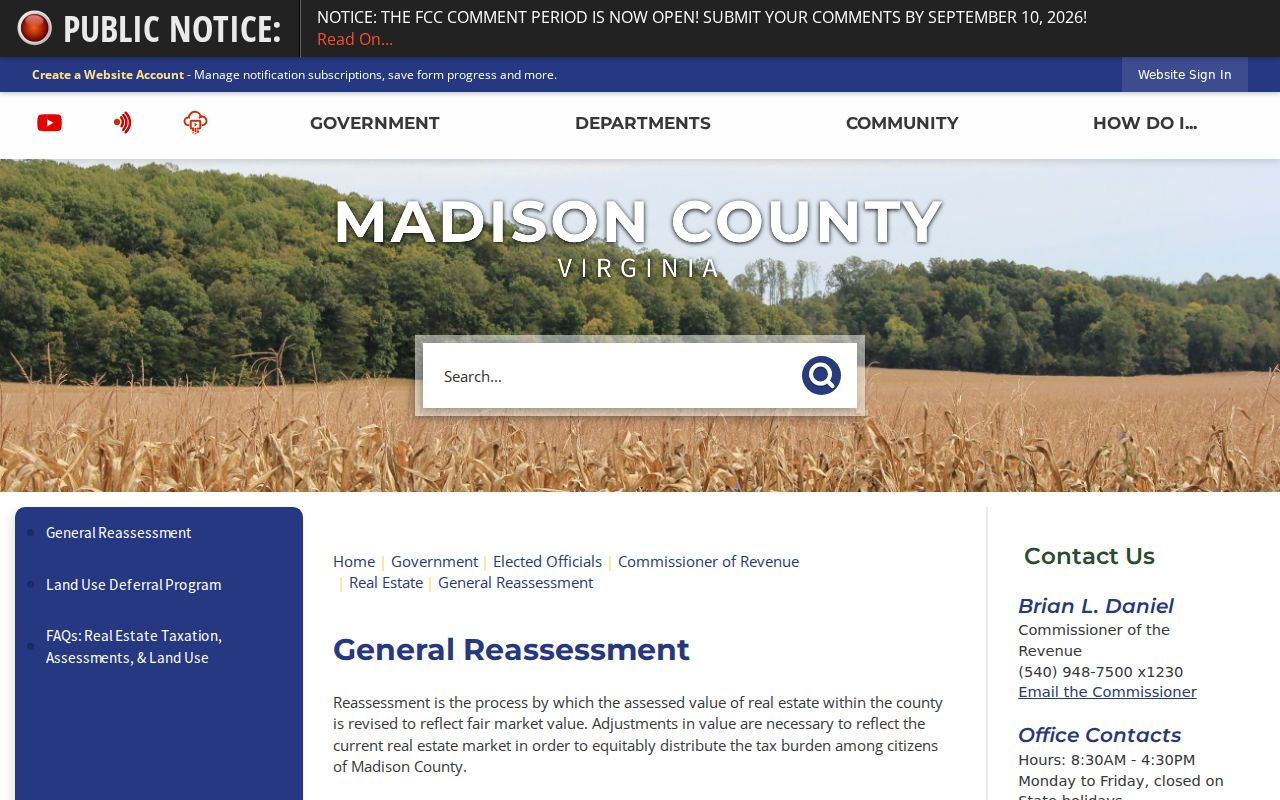
The county's 2025 reassessment page documents the local chronology. It also summarizes the cycle and appeal timeline.
Not every sale counts. The county may exclude unusually high or low prices from the market set, including sales under duress or premium purchases tied to a buyer's personal reasons. A deed's consideration is therefore not automatically a comparable for another parcel.
Appeal a Madison Assessment
The 2025 appeal calendar ran tight in Madison County. Notices went out the week of February 18. Assessor hearings concluded March 5, results were mailed by March 31, and Board of Equalization hearings wrapped up December 31, 2025. Those dates describe one reassessment year only. Check the current county notice and form whenever a new assessment arrives.
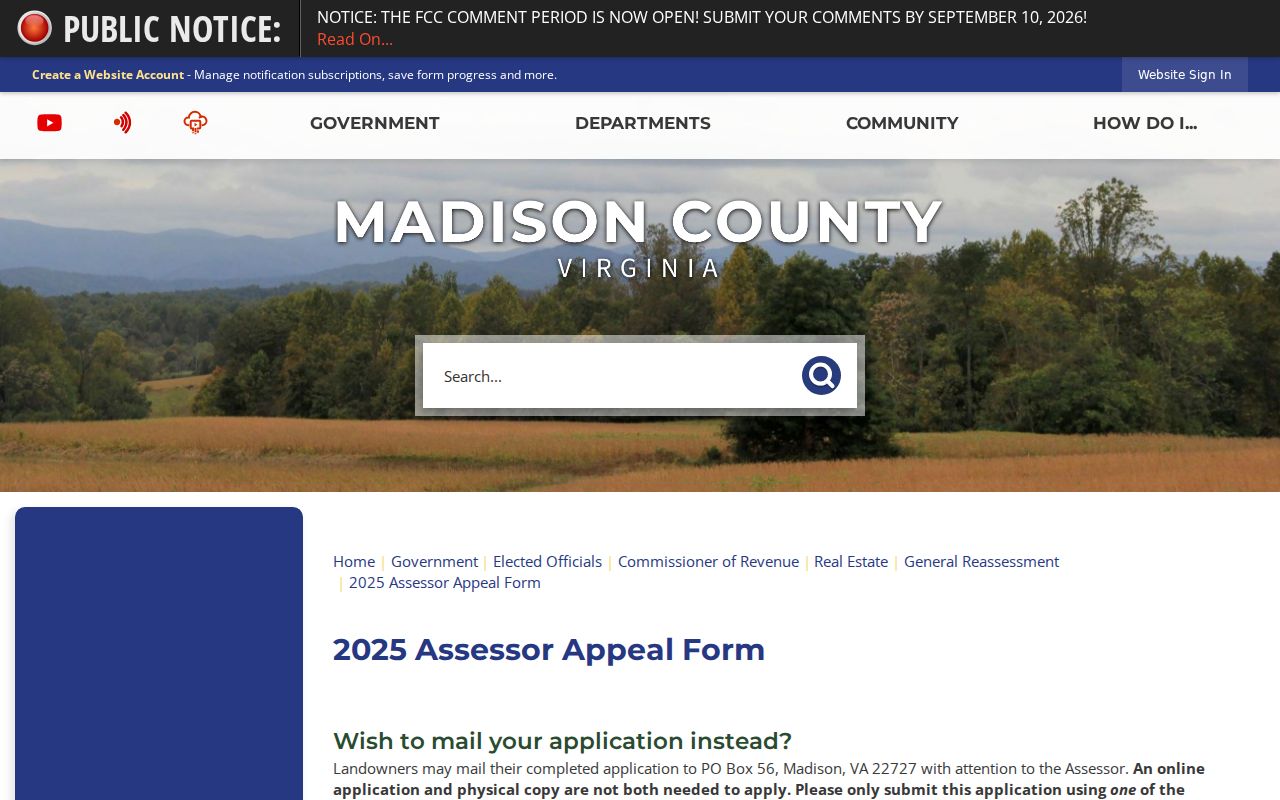
The Commissioner offers an online or printable assessor hearing application, with mail and drop-off directions on its page. Keep the argument factual. A strong appeal names the parcel, explains the disputed land or improvement fact, and attaches evidence such as a deed, recorded plat, or comparable property information.
The Madison County appeal form is the official request route. It comes in online and paper versions.
Keep the filed copy with the parcel number. That way the disputed assessment and its delivery date stay documented for any follow-up.
Land-Use Deferral in Madison
Madison County runs a land-use deferral. Qualifying agricultural, horticultural, and forest land carries both a fair-market value and a land-use value. While the land stays eligible, the tax bill rests on the use value, and the county calls this a deferral rather than an exemption because a disqualifying change later can trigger rollback tax.
Applications are due November 2. That deadline is firm. A $50 LU-1 application starts enrollment. A $50 LU-2 revalidation follows once every six years when no information has changed. Verify current eligibility and forms with the Commissioner before relying on an old card or planning a change in use, and check the official land-use program page for the values, forms, and deadlines.
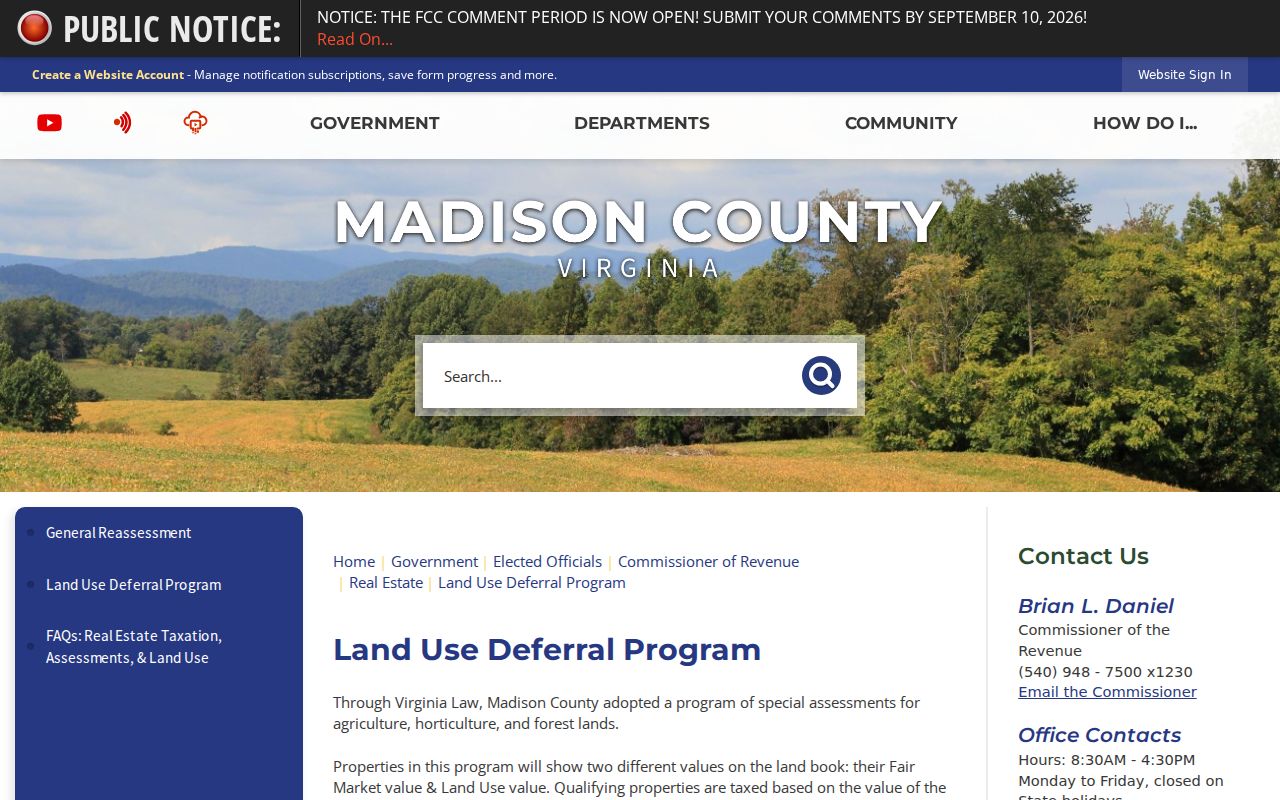
Talk to the Commissioner first. Confirm the acreage, the qualifying use, the application status, and the current deadline before budgeting from a deferred-use figure.
Madison Rollback Tax Triggers
Rollback can apply if enrolled land no longer qualifies, is put to a nonqualifying use, or is rezoned at the owner's request to a more intensive use. The research also identifies insufficient qualifying acreage and delinquent taxes as of June 1 after notice as possible triggers. The calculation may include the current year and up to five prior years, with interest and penalties.
The county says an owner has 30 days from the assessment date to pay a rollback bill in full to avoid additional interest or penalties. Ask the Commissioner for an estimate before a land-use or zoning change. The exact result depends on the parcel and trigger, so do not estimate it from the summary value alone.
General delinquency and tax-sale procedures are a different process. No current Madison tax-sale calendar or public list was located in the research. Contact the Treasurer and Clerk for the present process instead of assuming that a statewide schedule applies.
Public Assessment and Privacy
Madison County treats real-estate assessment information as generally public. One limit applies. The Commissioner says staff do not provide landowner personal contact phones or email addresses. A mailing address on a card is a tax correspondence destination, not a claim that the owner lives at the parcel.
Ask the Commissioner when an online field is blank. A written Virginia Freedom of Information Act request is the other route, and it must describe an existing record with reasonable specificity. A public body normally responds within five working days and may charge actual costs. It need not create new analysis to answer a question.
Values and billing answer different questions. The Madison County property value page covers what the assessment number means. Tax records are different. They track billing, review, and program rules.