
Trace Former Owners in Madison County
Build the timeline one transfer at a time. The newest deed names a grantee and a grantor, and that grantor's own earlier purchase becomes the next row in the chain. Check the legal description at every step. Doing so keeps the chain on the same land rather than on a neighbor with a similar name.
| Transfer date | Grantor to grantee | Instrument clue | Check against |
|---|---|---|---|
| Most recent deed date | Prior owner to current grantee | Deed type and recording reference | Current parcel description |
| Earlier transfer date | Earlier grantor to prior grantee | Book/page or instrument reference | Acreage, route, plat, adjoining owners |
| Older transfer date | Earlier grantor to earlier grantee | Index entry or scanned book | Same legal description or tract history |
Each prior owner is a documented step. Nothing is copied from a directory. Keep the deed date and the recording date in separate columns too, since they answer different questions about when a Madison County transfer actually happened and when the recorder entered it.
How Far Madison Records Reach
The Madison County Clerk holds deeds and index material dating to 1793. Standard remote land-record coverage starts July 1, 1991. Special Index scans cover two older windows, 1970 through June 1991 and 1793 through 1969, and deed books 60 through 101 plus books 1 through 59 are scanned as well. For a rural county, that gives former-owner research unusual depth. The Clerk's online-records information page explains the split between modern access and the scanned historical indexes and deed books visitors will encounter.
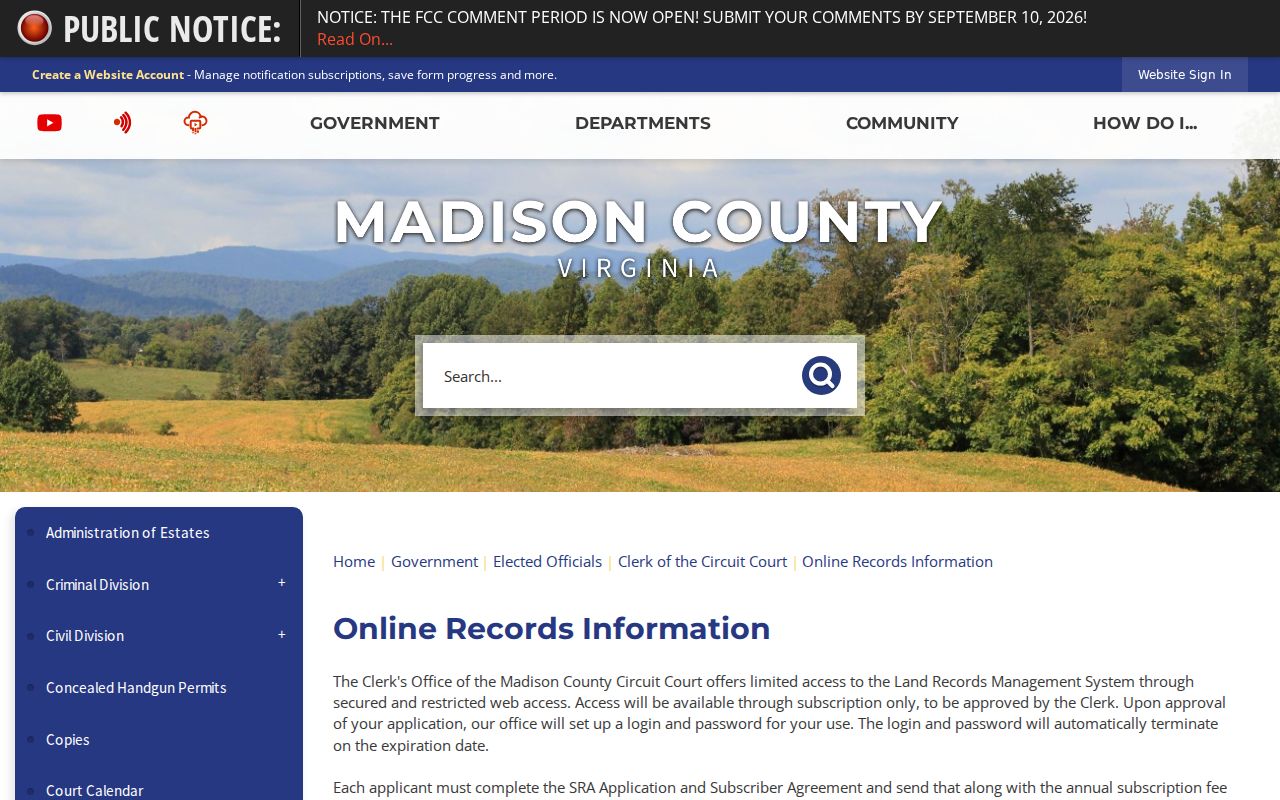
"Back to 1793" has a meaning worth understanding. The county reports scanned indexes and deed books, not a single modern search box containing every old name. Many pages are images, browsed by volume, year, and alphabetic section.
Madison Special Index Scans
The standard SRA and the Special Index cover different eras. Remote SRA access is subscription-based and starts with modern records. Special Index Search is the route to historical index scans and deed-book images. Logged-in search fields, document type menus, and result limits are not exposed publicly. Confirm those details at a courthouse terminal. Free inspection is available in the Clerk's public-access room at 1 Main Street. The room is open weekdays from 8:30 a.m. to 4:30 p.m. Ask staff which index or volume covers your date and parties. Do that before trusting a partial scan.
The Madison County genealogy and record-room page covers local research sources. It lists local deed, will, marriage, and order-book holdings along with courthouse access details.
Madison Deed Book Milestones
The deed imaging in Madison County moved forward in stages. Indexes and books covering 1970 through June 1991 were placed online in 2018. Older index scans and deed books 60–101 followed in 2022. Deed books 1–59 were scanned and uploaded in July 2023. Plat Books 27–40 began appearing in August 2019. More plat books were added as each book was finished.
Those milestones help you choose your source. You can use a modern database, an image index, or a bound volume at the courthouse. The earliest chains rely on names and written land descriptions. The current parcel number came much later. Record the book and page the moment you spot it. Then check it against the deed image itself.
Madison's courthouse dates to 1829–30 and joined the National Register in 1969. No official account of a courthouse fire destroying land books appears in county histories. So assume no missing decades when tracing an owner of record.
Madison Name and Description Variants
A backward search can stall when a name changes form. Search both grantor and grantee entries. Try initials and spelling variants too. Include the legal name of any trust, company, estate, or fiduciary. One person may have conveyed land as an individual in one deed. Another deed may show a representative acting for that same person.
Older Madison County deeds often identify land by adjoining owners. They also use acreage, road names, natural monuments, or plat references rather than a street address. Compare those details document by document. A surname match alone can splice together two unrelated parcels. It can also miss the same tract hiding under a different name form.
- Grantor
- The prior party who conveyed an interest.
- Grantee
- The party who received it.
- Chain of title
- A sequence of transfers linked to the same land or interest.
- Reverse search
- Following each recorded grantor back as a prior grantee.
- Quitclaim
- A deed conveying the interest stated without the same warranty promises as a warranty deed.
Estate Transfers in Madison
Probate can interrupt a clean name-to-name chain. Madison County Clerk records include wills and fiduciary materials. Standard online coverage starts in 2012. Older will books and indexes reach back to 1793. A transfer may be signed by an executor, administrator, commissioner, or heirs. Search the fiduciary name and the estate name along with the decedent's. Connect the probate order or appointment to the deed that actually conveyed the parcel. An obituary or will can establish identity or family context. It cannot prove a particular parcel passed to an heir. The deed's grantor, grantee, authority, and legal description remain the evidence that matters.
Closed death records follow separate Virginia eligibility and opening rules. A death certificate can confirm a date. The Clerk's probate and land records explain the transfer itself.
Madison Chancery Causes
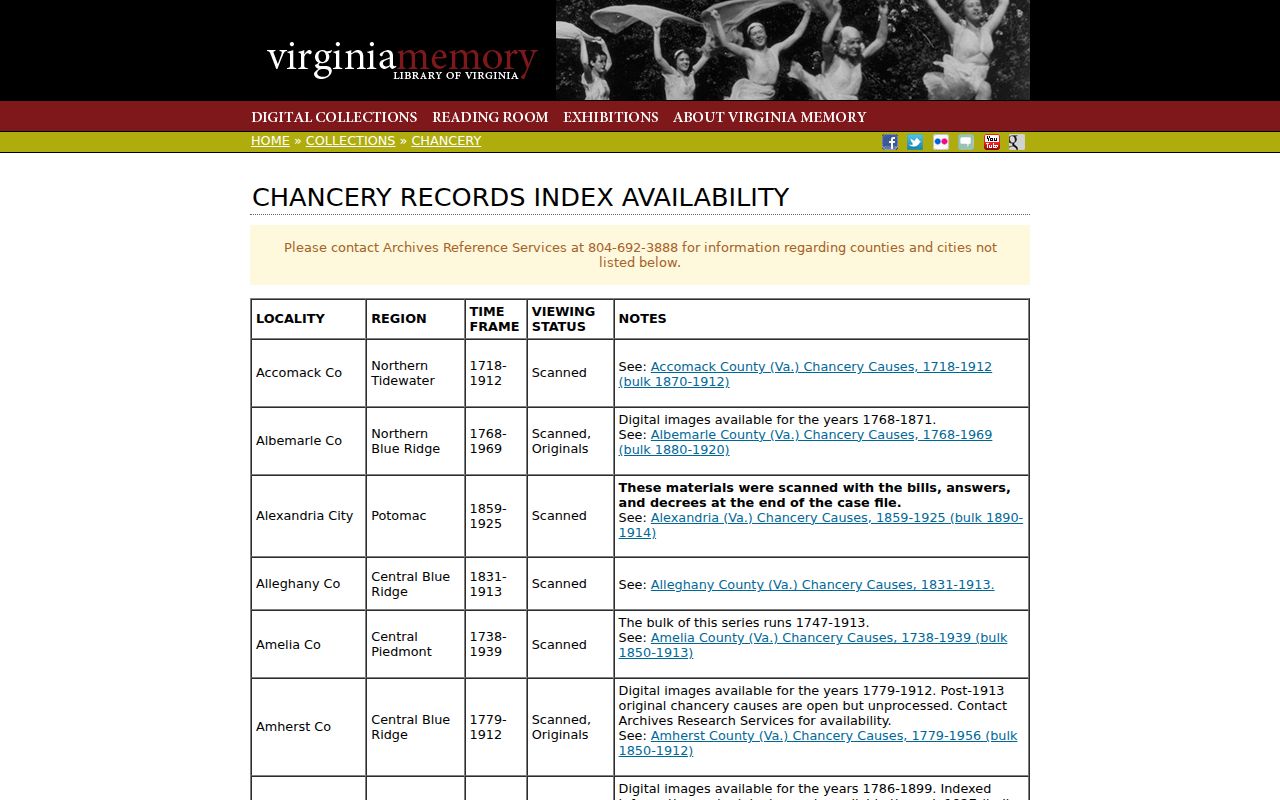
A deed trail sometimes runs dry. Boundaries, inheritances, and partition disputes rarely fit inside a single instrument. That is where chancery files help. The Library of Virginia's Virginia Memory collection covers Madison County causes from 1794 through 1913. Most files from 1873 through 1913 have been scanned. A cause may hold pleadings, depositions, exhibits, plats, and orders. These connect to a land fight or the division of an estate. For researchers tracing an owner of record backward, these papers often explain a gap the deed records leave open. Check the Library of Virginia's Madison chancery availability page to find the right cause. The listing shows which historical court-record files exist for the county.
Chancery papers supplement the land record. They do not replace it. Pull an exhibit or court order to pin down a deed, plat, or legal description, then compare it with the Clerk's recorded instrument.
Park Condemnation History
Madison County's digitized Shenandoah National Park acquisition files hold condemnation papers. The files also include appraisals and surveys. These date from the 1920s and 1930s. The county gave up one of the largest areas for the park. Some tracts resist a modern address lookup. Their old boundaries and prior owners are hard to trace. This collection can carry the story for those. The county genealogy page links the newly digitized records along with related court proceedings.
Hoover property materials offer another named route. The county links a Hoover deed, a deed and lease, and a deed of trust. Treat each instrument as part of a property history. Do not treat it as proof about a neighboring parcel. Old maps help too. The John Wood Map of 1821 and the first-patent map can orient an old tract. Confirm any result against deeds and later surveys.
What Prior Owners Prove
A name in an index proves little by itself. It shows only that the person or entity appears in a recorded instrument under that entry. Nothing more. It does not show that every interest in the land moved, that a deed covers the whole modern parcel, or that the person ever lived there. A life estate, easement, partial conveyance, or reservation can leave rights sitting outside the apparent chain of owners.
Recorded chain, not title opinion. Treat each prior owner as a step supported by an instrument. For a complete title determination, have the chain reviewed by a qualified title professional.
The Madison County deed-record page covers instrument types and access. Build a chain by connecting those records; a single index hit is just the starting point.