
Madison County Deed Types
Sales are only part of what the Madison County Circuit Court Clerk records. Deeds come in many types. The label names the instrument. The text and the legal description control what was actually conveyed. The table lists common documents to seek when researching a Madison County parcel. The same record will not always appear under the same online label.
| Instrument | What It Does | Common Research Use |
|---|---|---|
| General or special warranty deed | Conveys an interest with stated warranties | Find a purchase or transfer into a new owner |
| Quitclaim or deed of gift | Transfers the interest described without the same warranty structure | Review family, corrective, or limited-interest conveyances |
| Trustee, executor, or commissioner deed | Conveys under a trust, estate, court, or sale authority | Connect a transfer to a proceeding or fiduciary role |
| Deed of trust and release | Records a security interest and later satisfaction or release | Check whether an encumbrance was recorded as released |
| Plat, easement, or boundary agreement | Records lot layout, access, or a boundary-related instrument | Understand the parcel description and adjoining interests |
Madison County land records go well beyond deeds. Assignments, powers of attorney, leases, options, judgments, liens, financing statements, and correction instruments all sit in the same books as conveyances. One caution applies. A UCC financing statement often concerns business collateral and should not be read as a real-estate lien without checking what it covers.
Madison County Deed Index
A grantor conveys an interest; the grantee receives it. Party names drive the search. The Clerk's indexed names are the path from a Madison County deed index entry to an image or a book-and-page reference. Start with the name on the latest assessment card or deed, then check both the grantor and grantee side of the transfer. Companies, trusts, and estates need exact legal names.
- Identify a likely parcel in WebGIS or Concise CAMA and copy the owner name and legal-description clues.
- Search the Clerk index for the current grantee and find the newest deed that describes the same property.
- Record the grantor, grantee, deed date, recording date, document type, and book/page or instrument reference shown.
- Compare the legal description, acreage, road, plat, and adjoining owners with the parcel being researched.
- Search backward under the prior grantor as grantee, checking spelling, initials, entities, and estate representatives.
A name match is just a lead. The deed has to describe the right land. Rural tracts in Madison County may be defined by acreage, adjoining landowners, route names, natural monuments, or a recorded plat rather than a current street number.
- Grantor
- A person or entity conveying an interest.
- Grantee
- A person or entity receiving an interest.
- Chain of title
- The linked sequence of recorded transfers for the land or interest.
- Book and page
- A volume reference used in older records; newer systems may use an instrument reference.
Madison Deed Coverage by Era
Coverage splits by era. The eras are not alike. The standard remote channel for Madison County deed research is separate from the historical scan collection. The Clerk reports a modern SRA start in 1991, with image and index tranches that push the record trail back much earlier. Some of those scans are image-only. Browsing a year, volume, or alphabetic section may replace the current-style search a subscriber would use.
| Record period or set | Access detail | What to expect |
|---|---|---|
| July 1, 1991 onward | Standard remote land-record database | Subscriber access; exact field labels are not public |
| 1970 to June 1991 | Special Index scans reported from 2018 | Older indexing and images use a separate path |
| 1793 to 1969 | Scanned indexes reported from 2022 | Search by historical name and book reference |
| Deed Books 1–101 | Books 60–101 and 1–59 scanned in separate tranches | Compare book image with its index and legal description |
| Plat Books 27–40 | Scanned from 2019, with later additions as completed | Useful for recorded lot, road, and easement context |
The phrase "back to 1793" needs context. It describes the historical reach of Madison County's scanned indexes and books, not a guarantee of one searchable online interface for every year.
Standard SRA and Special Index
Secure Remote Access is the Clerk's paid subscriber route. It runs on approval. Applicants submit the business application and agreement for the Madison County Clerk's approval. The subscription term runs February 1 through January 31, with a stated annual fee of $600, and partial enrollment is charged at $50 per month until the next term. Accounts are inquiry-only and non-transferable. The agreement bars selling or redistributing the data. The Circuit Clerk's online-records page displays the deed coverage and the subscription path.
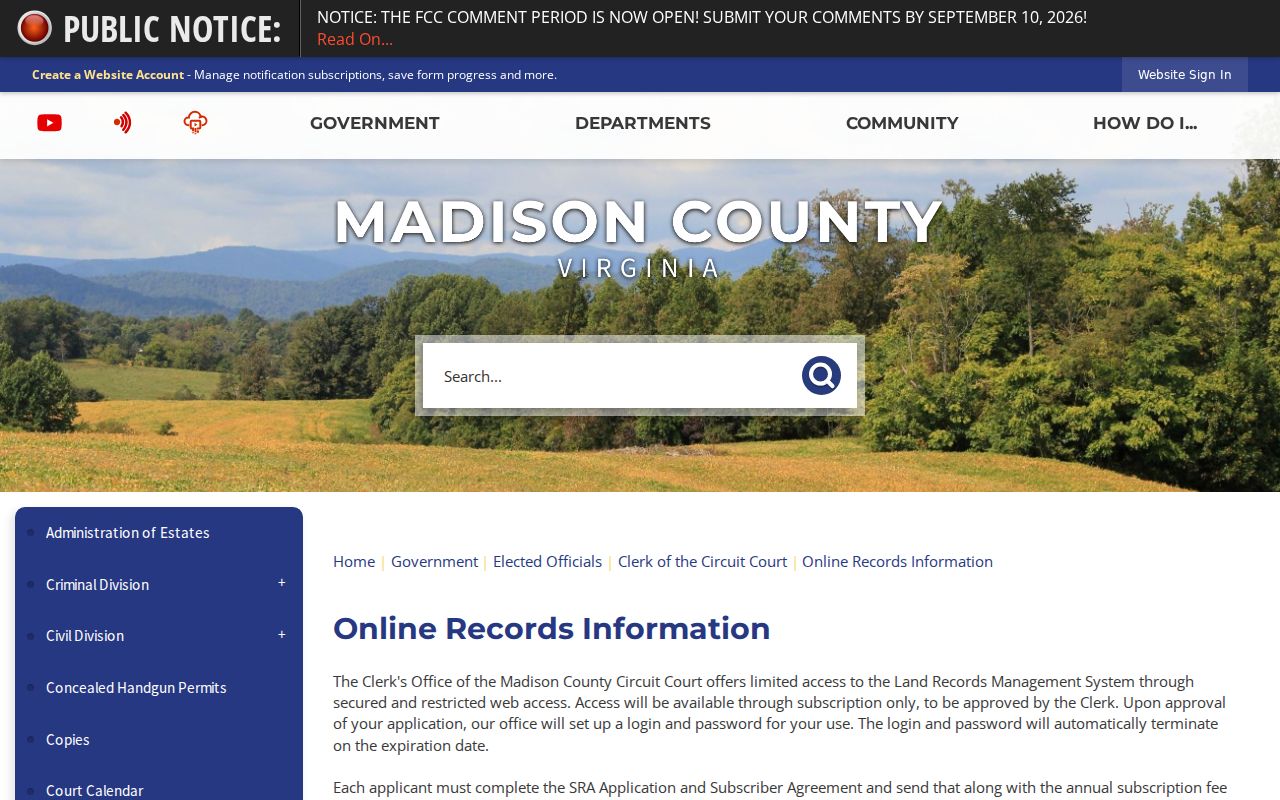
Match the era to the channel first. Coverage differs. The public page does not reveal the logged-in search fields, the result cap, or the sort and export choices a subscriber sees inside SRA. Older records follow the separate Special Index instructions. The Madison County Clerk can also say which book or scan covers the years in question. Ask the office when unsure. The Madison Clerk's online-records page explains the current coverage and the SRA application route.
Madison County Deed Copies
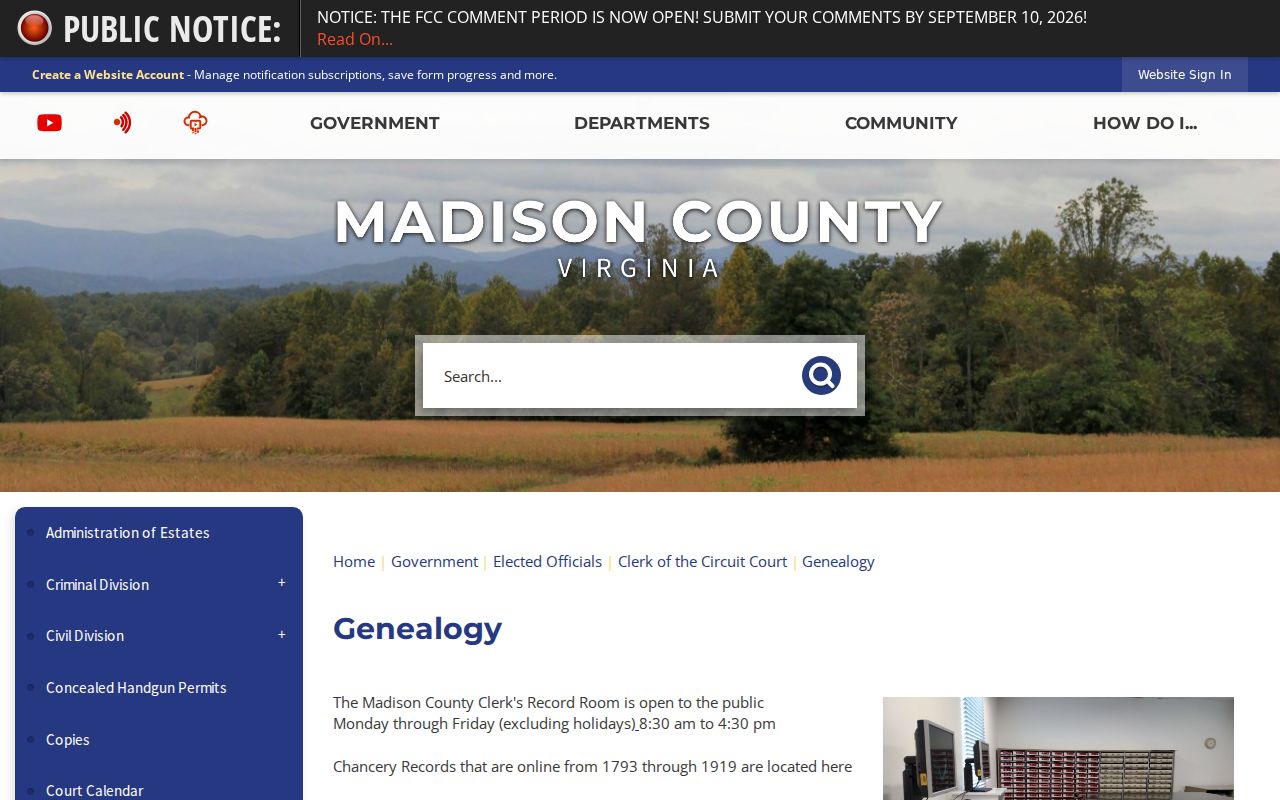
The Clerk's public-access room is the free alternative. It sits at 1 Main Street in Madison. Weekday hours run 8:30 a.m. to 4:30 p.m. Public computers let a researcher inspect Madison County deed records without an SRA subscription, though it pays to call ahead and confirm access arrangements before the trip. Staff record documents but do not search. Mail is the other copy route. The Clerk's form directs requesters to send the completed request, payment, and a self-addressed stamped envelope to Madison County Circuit Court Clerk, PO Box 220, Madison, VA 22727. No reliable current per-page or certified-copy fee is published. Confirm the amount with the office before mailing. The Madison County local record-room and genealogy page displays the courthouse collection and its historic holdings.
Be specific when you ask. A party name, approximate year, instrument reference, or parcel description gives the Clerk a concrete starting point for the Madison County deed file. Narrow requests help everyone.
Madison County Deeds and Liens
Deeds are only the start. A deed of trust, assignment, release, easement, right-of-way, restrictive covenant, judgment, lis pendens, or boundary agreement can change how a Madison County parcel is used or what interests surface in a title review. Trace by party name and legal description. The word "deed" alone will not carry you there, and a recorded release or satisfaction is the paper that shows an earlier security instrument was cleared. Madison's online coverage lists judgments and financing statements beginning January 3, 1995. Older material may need scans or a trip. Regular SRA access is inquiry-only. The agreement warns that online data may not be the official record, so obtain the official copy from the Clerk when a filing matters. Keep court files and land records separate. They answer different questions. Madison Circuit Court civil files can hold orders, pleadings, or exhibits, while the land-record index shows recorded instruments. A court result does not replace a deed or release entry.
Madison County Deed Plats and Surveys
Plats and boundary surveys live among the Clerk's land records. Plat Books 27 through 40 have been scanned and uploaded. More books join the set as scanning wraps up. A recorded plat can show lot lines, subdivision names, roads, easements, dedications, and the lots next door. For tracing a legal description to its source, a plat often beats a map screen. Just remember that an old plat is not the same as a current survey.
The county's WebGIS lines make a handy visual reference. They prove no exact boundary. When a property search turns up an encroachment, an acreage mismatch, or a line dispute, set the deed beside the recorded plat first. Then bring in a licensed surveyor. A tax-map identifier on a site-plan checklist can help orient a request, but it never overrides the recorded description.
The county Clerk page links deed books and plat access. The county zoning map adds flood and zoning layers for land-use context.
Estate Deeds and Heirs
Madison wills and fiduciary records explain why a later deed names an executor, administrator, commissioner, or individual heirs instead of the prior owner. Standard SRA coverage for wills and fiduciaries starts in 2012. Older will books and indexes go back to 1793. For earlier estate entries, use Special Index Search or the public record room.
Connecting an estate to land takes three steps. Identify the parcel. Locate the probate or fiduciary authority. Then inspect the estate's deed, deed of assent, distribution, or a later heir conveyance. Compare the legal description across every document. A will or an obituary may name a family relationship, but the deed and the court record show who had authority to transfer the property.
Virginia keeps closed vital records under separate eligibility and opening rules. A death record can confirm an identity or a date. It cannot establish a property transfer on its own.
Madison's Historic Title Files
The digitized Shenandoah National Park acquisition collection is a gold mine for property history. Madison County files from the 1920s and 1930s can include condemnation case papers. They may also hold appraisals, surveys, and related material. They show how a tract was described, valued, or acquired for the park. Ordinary current-owner search results rarely tell that story.
The County genealogy collection links those files and other local land-history resources. Madison's courthouse went up in 1829–30 and earned a National Register listing in 1969. County history records no courthouse fire that destroyed land books. So assume no missing-record gap.
Recorded Is Not Complete Title
A record indexed under one name may cover only part of a tract. It may also carry a limited interest. Deeds can reserve easements, life estates, minerals, access rights, or other interests, so search the grantor and grantee sides and read the full instrument. Compare the legal description with later conveyances before drawing any conclusion.
Recorded deed, not title opinion. A deed image documents an instrument in the Clerk's record. It does not certify that no other interest, lien, or exception exists. A complete title determination calls for professional title work.
Hunting prior owners means following grantor names back through the indexes and older books. The Madison County former-owner trail focuses on that backward chain. This deed-records route centers on finding and understanding the instrument itself.